![Blogs at NOC [logo]](/themes/NOC8X-main/logo.svg)
by Pablo Trucco Pignata (Research Scientist) with Eleanor Frost, National Oceanography Centre (NOC)
Each summer, scientists from across Europe set sail into the high Arctic for the annual Fram Strait expedition, one of the world’s longest-running and most important climate observatories. Here they monitor the exchange of water masses across the only deep gateway between the Arctic Ocean and the North Atlantic, and with them the transport of heat, freshwater, and salt, each critical to regulating global ocean circulation and regional climate.
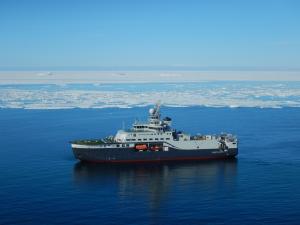
This July, aboard the Norwegian research icebreaker RV Kronprins Haakon, the National Oceanography Centre (NOC) team had a specific mission at hand - to deploy a new suite of state-of-the-art autonomous Lab-on-Chip (LoC) sensors on the long-term moorings in the East Greenland Current and provide novel year-round biogeochemical data not previously available.
It's part of a decades-long effort, led by the Norwegian Polar Institute (NPI), to monitor one of the global ocean’s most important transport gateways, and in particular the East Greenland Current (EGC), where cold, fresh Arctic waters flow southward into the subpolar North Atlantic.
Advancing Arctic science
Fram Strait is critically important to ocean research, but year-round observations are difficult to make due to the area’s remoteness and harsh conditions. To overcome this, the use of subsurface tall moorings has enabled measurements to be made throughout the water column at all times of year, but - until very recently - they have focused on physical characteristics (temperature, salinity, current speed) and limited biogeochemical parameters.
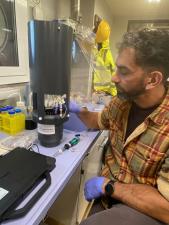
NOC’s cutting-edge autonomous technology will now usher in a step-change in our abilities to measure long-term variability across a suite of biogeochemical tracers in these waters exiting the Arctic. The compact LoC biogeochemical sensors have been deployed in the Fram Strait Arctic Outflow Observatory and will measure key indicators of ocean health year-round, including:
- pH and total alkalinity to track Arctic Ocean acidification and carbonate cycling; and
- Nitrate and phosphate to monitor nutrient fluxes and variations in nutrient stoichiometry that shape ecosystem dynamics.
NOC’s LoC sensors have been developed to be robust, low-power and deep-water rated, which makes them ideal for polar environments. They will allow researchers to monitor Arctic change as it happens, even through the long, dark polar winter.
The data collected will fill gaps in our understanding of how Arctic biogeochemistry is changing and the downstream impacts it has on ecosystems and carbon fluxes in the subpolar North Atlantic.
A Collaborative Approach
This year’s work has been the most ambitious and collaborative yet, with researchers from institutions in the UK, Norway, Poland, Denmark and France working together to investigate how changes in the Arctic are reshaping our oceans, ecosystems and climate.
NOC’s contribution is part of the international EPOC project (Explaining and predicting the ocean conveyor), a major Horizon Europe project focused on improving carbon cycle observations, and BIOPOLE, a UKRI-funded programme exploring the connections between polar biogeochemistry and global change.
By contributing advanced sensing systems alongside scientific leadership, NOC is helping to position the UK as a key partner in international Arctic research.
Why Fram Strait?
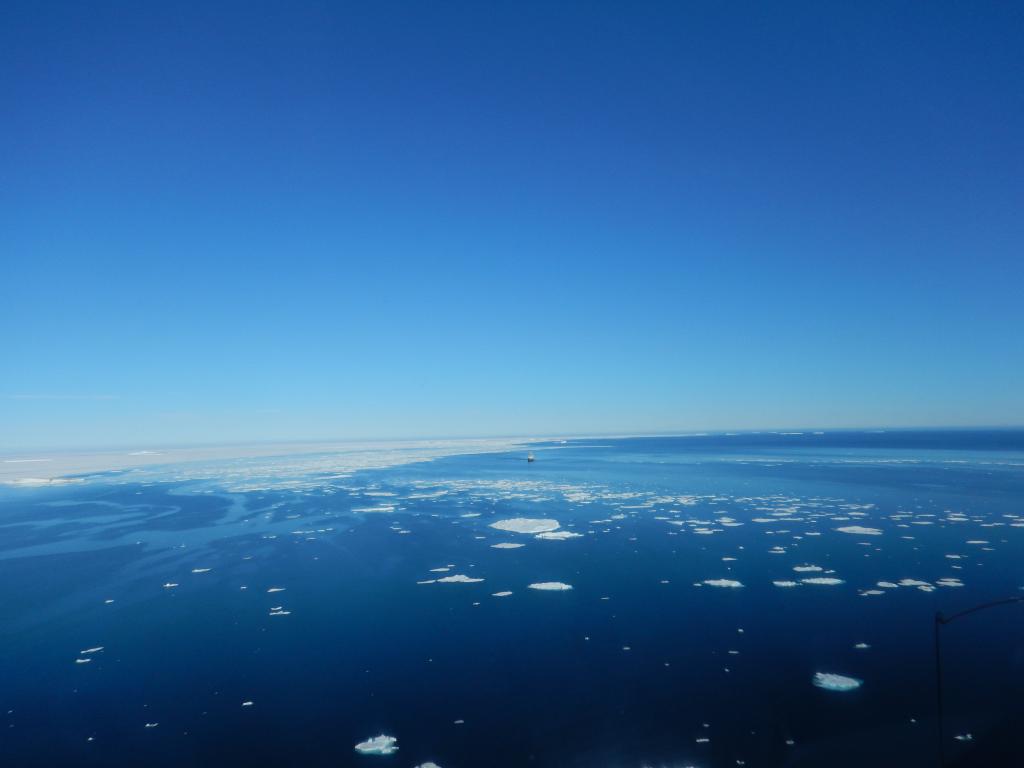
As one of the major gateways to the Arctic, the Fram Strait is vital to our understanding of the ocean.
It serves as a key pathway for the exchange of water masses between the Arctic and the North Atlantic - bringing warm, saline Atlantic water northward and returning cold, fresh Arctic waters southward - and represents a major route for the export of nutrients and carbon from the Arctic Ocean.
These Arctic waters carry a unique chemical ‘fingerprint’, characterised by a lower N:P ratio than Atlantic inflow waters and already strongly affected by ocean acidification, which is intensified as sea-ice loss increases CO₂ uptake and surface freshening reduces the buffering capacity of Arctic waters.
What will this research achieve?
While the NPI has monitored the Arctic freshwater, sea ice and returning Atlantic water in the EGC in the Fram Strait Arctic Outflow Observatory since the 1990s, biogeochemical properties have only been measured in late summer through a water sampling programme during the annual cruises.
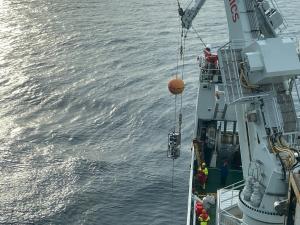
By combining carbonate chemistry and nutrient measurements in this remote gateway, the newly installed LoC sensors will provide year-round data that has never been captured before.
These observations will improve estimates of Arctic nutrient and carbon exports, support international ocean acidification monitoring, and demonstrate how UK-developed autonomous technology can extend our reach in challenging environments.
Tracking these biogeochemical properties helps us understand not only what is happening in the Arctic, but also how it influences ecosystems and carbon cycling further south.